Buying Workbenches Direct: How Made-to-Order Manufacturing Works
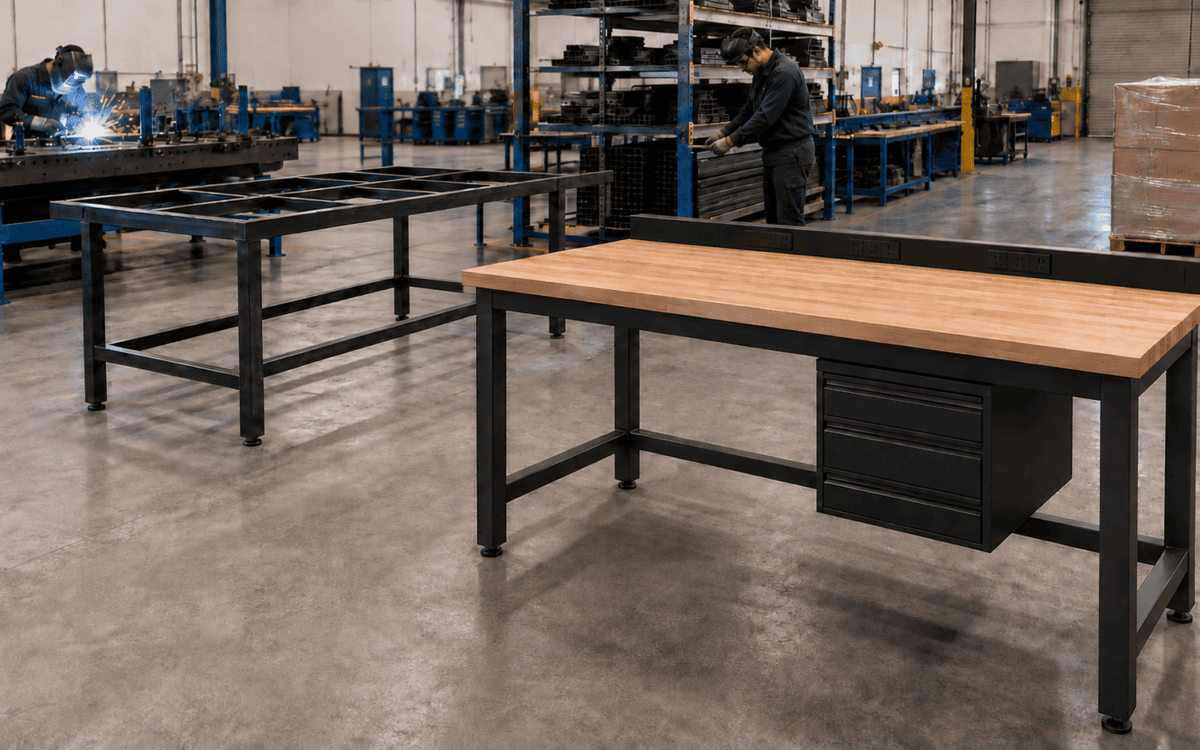
Buying directly from a workbench manufacturer is most useful when the furniture must fit a real process, not just a room. The buyer can define the task, equipment, materials, dimensions, storage, utilities, environment, schedule, and delivery conditions with the same team that will configure and manufacture the furniture. That direct connection is especially valuable for laboratories, manufacturing facilities, government agencies, defense contractors, and organizations standardizing workstations across several locations.
Made-to-order does not mean every project must begin as a custom engineering exercise. Many requirements fit a standard configuration. Others need only a modified size, material, or accessory. True custom work is reserved for applications that cannot be served responsibly by standard configurations. Knowing which path applies makes the quote clearer and helps protect the schedule.
The short answer: Start in the 3D Workbench Designer or submit a project inquiry. A product specialist reviews the application, confirms the missing details, and develops the quote. A complete standard or modified request can often be quoted within about two business days. After the purchase order and required approvals are received, the order moves through final review, production, shipping, and invoicing. Typical manufacturing lead times are 3 to 4 weeks for standard products, 4 to 6 weeks for modified products, and 6 to 12 weeks for custom solutions. Current timing must be verified for each project.
Made-to-order purchasing at a glance
The table below separates the milestones that are often combined under the word lead time. A quote turnaround, drawing approval, manufacturing lead time, delivery transit, and installation schedule are different parts of the project.
| MILESTONE | WHAT HAPPENS | TYPICAL PLANNING POINT |
|---|---|---|
| Initial review | Product fit, contact information, project timing, and basic requirements are checked. | Often begins the same business day. |
| Quote development | Dimensions, quantities, materials, finishes, accessories, shipping, and other project requirements are priced. | About 2 business days for a complete request; complex custom work may take longer. |
| Order release | The buyer submits a purchase order. Workbenches.com and the buyer then confirm any remaining design approvals, commercial details, and payment arrangements. | Manufacturing timing begins after the purchase order and required approvals. |
| Manufacturing | Materials and special components are confirmed, production is scheduled, and the furniture moves through fabrication, assembly, and quality checks. | Standard: 3 to 4 weeks. Modified: 4 to 6 weeks. Custom: 6 to 12 weeks. |
| Delivery and installation | The order ships, tracking is provided, and installation occurs if it was included in the project. Finished-project photography can also be coordinated separately when requested and permitted by the facility. | Transit and site access are planned separately from manufacturing. |
Timing note: These ranges are typical, not guaranteed. Seasonal demand, production capacity, material availability, the longest-lead component, drawing approvals, and changes after quoting can affect the schedule. A product specialist should verify current timing before the buyer commits to a project date.
PART 1 | FROM FIRST CONFIGURATION TO DELIVERY
What’s the typical process for planning a new workspace furniture project?
A typical project moves from application planning to configuration, quote, purchase order, final approval, engineering review, production, shipping, and invoicing. The fastest starting point is the 3D Workbench Designer because it gives the product specialist a visible configuration to review, even if the final project will be modified or custom.
Begin with the work itself. Define the tasks, equipment, operators, environment, quantity, schedule, and room constraints before choosing accessories. The 3D Workbench Designer can then be used to select dimensions, worksurfaces, powder-coat finishes, storage, shelving, and other options. The saved design becomes a practical starting point for discussion rather than a final engineering approval.
A made-to-order project usually follows these customer-facing stages:
Some stages overlap, and repeat orders based on an unchanged approved configuration may move through the process more quickly. Every order is still checked against current materials, quantities, delivery details, and production capacity.
How long does it typically take to get a quote on a custom-configured workbench?
A complete workbench request can often be quoted within about two business days. A true custom project may take longer when the team must evaluate a new frame, unusual equipment, non-standard materials, special load requirements, or a configuration that needs engineering input before it can be priced accurately. Project size can also affect turnaround because quoting one workstation is different from coordinating hundreds of workstations, multiple station types, phased deliveries, or installation requirements.
Quote turnaround depends less on the number of emails and more on whether the decision-making information is complete. Dimensions, quantities, worksurface and finish selections, accessories, equipment details, shipping address, schedule, and installation needs should be provided together whenever possible. Photos or drawings can help, provided the facility permits them to be shared. For large laboratory projects, architectural plans are especially useful for understanding room layouts, utilities, clearances, and installation conditions.
An initial request is often reviewed quickly, sometimes within a few business hours, but the useful milestone is an accurate quote. The two-business-day target is a practical expectation for a complete standard or modified request, not a promise for every custom project. If an approval deadline matters, state it at the beginning so the product specialist can tell you whether the schedule is realistic.
Quote turnaround is not the same as manufacturing lead time. Manufacturing timing generally starts after the purchase order is received and required drawings, payment arrangements, and other release conditions are complete.
How does quoting work for a large, made-to-order order of workbenches?
A large project is quoted most efficiently by grouping workstations into repeatable types, defining the quantity and options for each type, and providing one coordinated delivery and installation plan. The final quote normally includes the furniture configuration, quantities, freight, and requested project services.
The goal is to make variation intentional. A facility might define Station A for electronics assembly, Station B for inspection, and Station C for supervisor or test equipment use. Each station type should have a controlled list of dimensions, worksurface, frame finish, storage, power, lighting, shelving, monitor mounts, and other accessories. That structure reduces ambiguity without forcing every operator into the same layout.
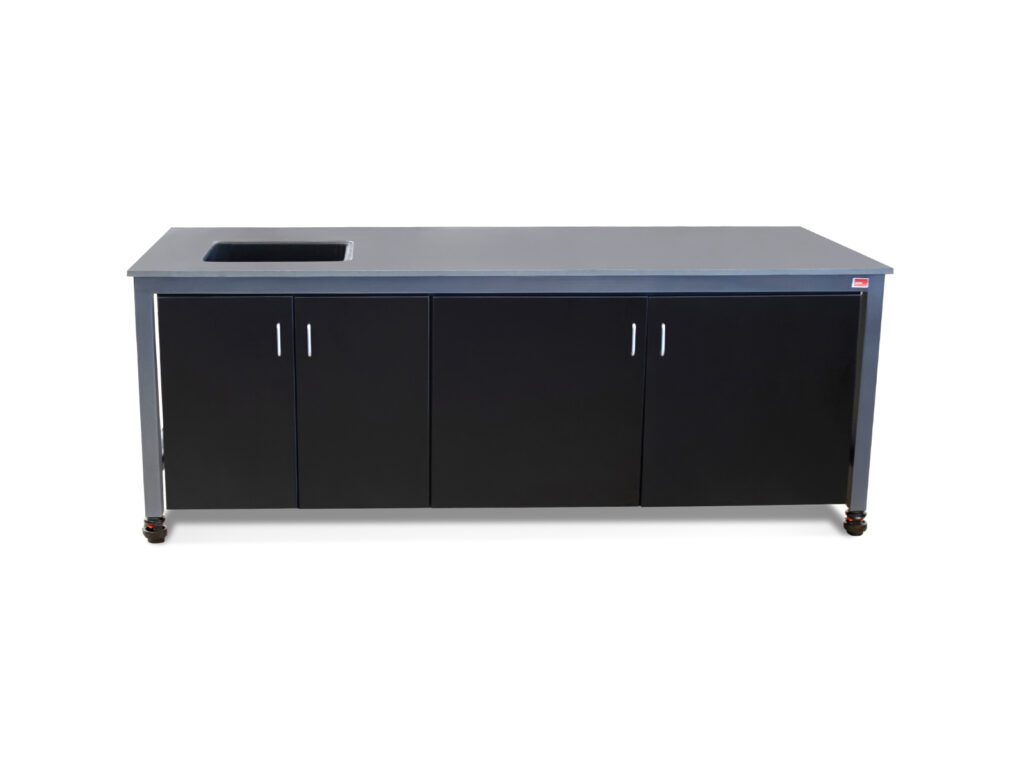
For an accurate large-project quote, provide:
Shipping cost is included with the final quote. Installation can also be requested and quoted when the furniture is manufactured by Workbenches.com. Installation details should be discussed before the order is released because access, staging, floor protection, elevators, stairs, permits, insurance, and after-hours work can change both cost and scheduling.
Once we have a quote in hand, what does the direct ordering process look like for a government lab or agency?
After the agency accepts the quote, it submits a valid purchase order and any required procurement or vendor documentation. Workbenches.com confirms the order, shipping and billing information, design details, drawings when applicable, payment terms, and expected ship timing before the order is released for engineering review and production.
The purchase order should match the quote, including product descriptions, quantities, prices, freight, bill-to and ship-to addresses, and referenced terms. If the purchase order contains all accepted quote information, a separate signed quote may not be necessary. Any mismatch should be resolved before release so the manufactured furniture, invoice, and agency records remain aligned.
Standard products can generate a drawing as part of configuration and quoting. Modified or custom quote-stage drawings may be created when needed to validate the concept. After order acceptance, 2D acknowledgement drawings are typically shared to confirm the approved configuration. A standard product normally does not require a drawing signature, while modified and custom work may require written approval before production details are completed.
| DRAWING STAGE | WHAT THE BUYER SHOULD EXPECT | APPROVAL POINT |
|---|---|---|
| Configuration or quote | A standard configuration can generate a drawing. A modified or custom concept drawing may be provided when the project needs visual clarification. | Used to support selection and pricing; not always a production release. |
| Order acknowledgement | A 2D drawing is typically shared with the acknowledgement to confirm the ordered configuration. | Standard products normally need no signature. Modified or custom work may require approval. |
| Production engineering | Detailed work-order drawings define manufacturing information for modified or custom furniture. | Reviewed internally by engineering; buyer approval is requested when a customer-facing decision remains. |
Finance then confirms the agency’s billing information, credit or payment arrangement, purchase-order alignment, and applicable terms. Engineering verifies buildability, completeness, inventory, and any special-order components. Production timing is established after those release conditions are complete.
What should I know before buying workbenches directly from a manufacturer instead of a dealer?
Buying direct gives the buyer a clearer path from application requirements to the team configuring and manufacturing the furniture. Removing an additional communication layer can shorten response loops, reduce handoffs, and improve control over drawings, options, changes, and repeat orders. The tradeoff is that made-to-order furniture still requires complete requirements, timely approvals, and realistic manufacturing and delivery planning.
A direct purchase works best when the buyer wants more than a generic stock table. Product specialists can help connect the requested dimensions, worksurface, frame, storage, utilities, accessories, and environment to an available configuration. Modified and custom projects can then involve engineering without the buyer having to translate the requirement through another sales channel.
Direct does not mean every configuration is ready to ship immediately. Standard, modified, and custom products are made to order. Some special materials and components are purchased after the purchase order is received because Workbenches.com uses a just-in-time manufacturing approach. The component with the longest current lead time may determine when production can begin or finish.
Before ordering, review the scope, drawings, freight, installation, payment terms, warranty, and change process. The Workbenches.com warranty information should be reviewed alongside the final quote. If an eligible configuration is needed on an accelerated schedule, the 3D Quick Ship Bench Designer can be used to explore the current Quick Ship program.
Once the buying process is clear, the next decision is how much configuration the application actually needs. Choosing the simplest category that fully supports the work is usually better than defaulting to custom.
PART 2 | CHOOSING STANDARD, MODIFIED, OR CUSTOM
How do I know if a standard configuration is a better fit than a custom build for my project?
Choose a standard configuration when an available size, worksurface, finish, and accessory package supports the work without changing the underlying design. Choose modified when the standard platform works but needs an in-between size or non-standard material or accessory. Choose custom when the operation requires a solution that must be engineered specifically for the task or environment.
| CATEGORY | BEST FIT | TYPICAL LEAD TIME |
|---|---|---|
| Standard | Available standard sizes, worksurfaces, finishes, and accessories meet the application. | 3 to 4 weeks |
| Modified | The standard platform works, but an in-between size or non-standard accessory or material is required. | 4 to 6 weeks |
| Custom | The product is neither standard nor modified and must be engineered for the operation, equipment, load, layout, or environment. | 6 to 12 weeks |
Standard is often the better choice when it meets the functional requirement because it uses an established platform, simplifies approvals, and typically carries the shortest made-to-order lead time. Accessories can still personalize the workstation without turning it into a custom design.
Modified is appropriate when a small but important change is required, such as a dimension between standard sizes, a non-standard worksurface, or an accessory not included in the normal configuration. A buyer can start in the 3D Workbench Designer, then describe the modification to a product specialist.
Custom should be selected when the application drives new engineering, such as unusual equipment integration, reinforced or specialized geometry, a process-specific cutout, a unique mobile system, or furniture for a constrained environment. The Personalized Workbenches and Custom Commercial Furniture page shows the range of applications that can require this approach.
Lead times begin after the purchase order and required approvals are received. They are seasonal and may change with material availability, production capacity, or the longest-lead component. Confirm current timing for the exact configuration before setting the facility schedule.
What questions should I ask before specifying workbenches for a new facility?
Ask what work will be performed, what equipment and loads the bench must support, which environmental controls apply, how operators will use the station, what utilities and storage are needed, how the furniture will enter the building, and when the project must be operational. These answers should be settled before final dimensions and accessories are approved.
A useful specification begins with the following questions:
When the process generates fumes or vapors, furniture selection must be coordinated with the appropriate ventilation and safety plan. A workbench is not a substitute for a properly selected laboratory hood.
How do organizations standardize furniture across multiple locations?
Organizations standardize successfully by creating a small family of approved workstation types, documenting the fixed requirements and allowed options for each type, and using controlled drawings or configuration records for repeat orders. Site-specific delivery, utilities, codes, and room constraints should remain separate from the core furniture standard.
A standardization program should define what must remain consistent and what may vary. For example, the frame platform, worksurface, ESD system, finish, drawer construction, and accessory rail may be fixed. Width, storage quantity, monitor mounts, or left-right orientation may be controlled options. This produces repeatability without ignoring legitimate differences among sites.
A practical multi-site approach is to:
An unchanged repeat order may move more directly into production because the basic design is already established. It still requires validation of quantity, delivery details, current material availability, and the version of the approved configuration. Workbenches.com can also create a custom order catalog so other locations within the same organization can order approved configurations built to the company’s standards.
Government agencies and defense contractors use the same basic made-to-order process, but procurement, documentation, domestic sourcing, ESD, and secure-site requirements can add decision points. Those conditions should be identified before the quote is finalized.
PART 3 | GOVERNMENT AND DEFENSE PURCHASING
Can government research labs buy furniture directly from a manufacturer?
Yes. Federal, state, and local government research labs can purchase directly from Workbenches.com when their procurement rules allow a direct manufacturer purchase. Workbenches.com can accept government purchase orders and respond directly to agency quote requests, formal bids, and RFPs.
Workbenches.com is not currently listed on GSA Schedule or another government contract vehicle. An agency that requires a specific contract vehicle should confirm the allowed procurement path before requesting a quote. An agency that is permitted to buy directly can work with a product specialist to define the furniture and issue a purchase order under its normal process.
Workbenches.com can also sell to a defense contractor purchasing furniture for its own laboratory, manufacturing operation, or secure facility. It does not currently participate as a supplier to third-party resellers or bidders that intend to include Workbenches.com furniture in their own government contract. That distinction should be discussed early when the requester is not the end user or purchasing agency.
Workbenches.com is a U.S. company, and the furniture it sells is built in the United States. Domestic manufacturing may support a project’s sourcing goals, but the purchasing organization remains responsible for identifying the exact statute, contract clause, country-of-origin test, certification, or flow-down requirement that applies.
Can workbenches be purchased directly by a government research lab, or is a formal RFP required?
A formal RFP is not required for every government purchase. The correct route depends on the agency’s procurement rules, purchase value, funding source, competition requirements, and required contract vehicle. Workbenches.com can provide a direct quote or respond to a formal solicitation issued directly by the agency.
The manufacturer does not decide whether the agency must use a request for quotation, invitation for bid, RFP, simplified acquisition procedure, or another method. The agency’s contracting or purchasing team should determine the process. The furniture team can then provide the technical description, drawings, pricing, freight, lead time, and requested vendor information in the required format.
If the agency intends to buy directly, identify the contracting contact, submission deadline, required forms, evaluation criteria, delivery terms, and any mandatory clauses at the start. If a formal solicitation is required, allow time for questions and answers, technical review, revisions, award, purchase-order processing, and post-award design confirmation before manufacturing begins.
What documentation should a facility expect to provide when requesting a quote as a government buyer?
A government buyer should provide the agency and contact information, bill-to and ship-to details, quantities, technical requirements, procurement method, required forms and clauses, delivery and installation constraints, and the project schedule. The exact package depends on the agency and the purchase.
Information commonly needed from the buyer includes:
Workbenches.com can provide vendor documentation, quote details, product information, drawings, freight information, and other project records as applicable. Because government documentation varies, the buyer should identify mandatory forms and representations rather than assuming a generic vendor packet will satisfy the procurement.
What furniture requirements are common in government and defense lab environments?
Common requirements include documented dimensions and load capacity, materials suited to the process, ESD control for sensitive electronics, cleanable configuration, secure storage, ergonomic adjustability, integrated utilities, domestic sourcing, and delivery procedures compatible with the facility. The application determines which requirements actually apply.
There is no single government or defense workbench specification. A chemistry lab, avionics repair area, cleanroom, training facility, and heavy-equipment maintenance shop require different surfaces, frames, accessories, and documentation. The right specification begins with the task and then adds agency or contract requirements.
| REQUIREMENT AREA | QUESTIONS TO RESOLVE BEFORE QUOTING |
|---|---|
| Performance | Required dimensions, total and concentrated loads, vibration sensitivity, equipment mounting, mobility, and expected service conditions. |
| Materials | Chemical, heat, moisture, abrasion, corrosion, cleaning, and contamination requirements for the worksurface and frame. |
| ESD and controlled environments | Applicable ESD control plan, cleanroom classification, grounding, test criteria, cleaning protocol, and approved accessories. |
| Operator and workflow | Seated or standing work, height adjustment, reach zones, storage, lighting, monitors, power, data, and material flow. |
| Security and access | Approved drawings and file handling, delivery windows, identification, escorts, staging, vehicle restrictions, and installation controls. |
| Procurement and documentation | Purchase method, domestic-sourcing clauses, vendor forms, insurance, terms, approvals, and required delivery records. |
Facilities with particle-control requirements should review Cleanroom Solutions. Facilities handling sensitive electronics should review the complete ESD Furniture Solutions rather than treating the worksurface as the entire control system.
What furniture specs are typically required for defense and aerospace lab environments?
A defense or aerospace specification typically defines the task, equipment footprint, bench dimensions, load rating, worksurface, frame material, ESD requirements, storage, utilities, ergonomics, mobility, cleaning needs, and equipment integration. It should also state any contract, documentation, domestic-sourcing, or secure-facility requirements.
The application matters more than the market label. An avionics assembly station may need a static-dissipative worksurface, verified grounding, task lighting, power, monitor arms, and organized component storage. An inspection station may prioritize stability, lighting, instrument clearance, and operator positioning. An MRO or fabrication bench may require a reinforced frame, durable top, fixtures, tool storage, and a much higher load rating.
The Aerospace Workbenches page outlines common applications including avionics, inspection, component fabrication, and maintenance. For heavy tooling, large fixtures, or demanding industrial use, review the Heavy-Duty Furniture Solutions as a separate design path.
Avoid vague requirements such as aerospace-grade, defense-grade, heavy-duty, or ESD-safe without measurable criteria. State the load, dimensions, materials, electrical properties, environmental conditions, equipment, required standard, and acceptance method. If a contract clause or facility standard applies, provide the exact document and revision to the product specialist.
How do defense contractors typically specify ESD workstations?
Defense contractors should specify ESD workstations from the facility’s ESD control plan. The request should identify the devices and processes being protected, required worksurface electrical properties, grounding method, personnel grounding, accessories, testing and verification, applicable standards, and the relationship to the facility’s flooring and other controls.
An ESD worksurface is one part of the system. A complete specification may address the static-dissipative top, grounding hardware, common-point ground, wrist-strap connections, ESD seating, storage, carts, shelving, tools, flooring, footwear, test instruments, inspection frequency, and employee procedures. A metal bench or a grounding cord by itself should not be assumed to satisfy the facility’s ESD program.
If ANSI/ESD S20.20 or another standard is required, state that requirement and the facility’s acceptance criteria in the quote request. Workbenches.com can configure the furniture and accessories around the stated requirements, but the contractor’s ESD coordinator should confirm that the complete workstation fits the site’s control plan and verification procedure.
Useful configuration choices include height adjustment, monitor mounts, integrated power, lighting, storage, shelving, and mobile options. Review them together on the ESD Furniture Solutions page and in the 3D Workbench Designer.
What’s different about furnishing a lab inside a secure government facility?
Workbenches.com is an American manufacturer, and the furniture it sells is built in the United States. This allows agencies and contractors whose security or sourcing requirements favor domestic suppliers to work directly with the team configuring and manufacturing the furniture without sending project specifications to an overseas manufacturer. Secure projects also require more planning because facilities may restrict photography, electronic files, deliveries, personnel access, tools, work hours, staging, escorts, and installation procedures. These conditions should be identified before the quote is finalized.
Do not assume that a normal commercial delivery can arrive and enter the building without advance coordination. The project team should identify the approved receiving location, delivery contact, vehicle and driver requirements, access hours, identification or background requirements, escort rules, loading and staging areas, doorway and elevator clearances, prohibited devices, tool controls, cleanup requirements, and installation sign-off process.
Secure information also changes how the furniture is specified. Use only approved drawings, photos, equipment descriptions, and file-transfer methods. If room photographs are prohibited, provide permitted dimensions, redacted layouts, equipment envelopes, or an approved statement of work. The facility security officer or contracting team should decide what may be shared.
Installation should be planned early. The Workbenches.com installation request asks about permits and paperwork, photo-identification requirements, hours of accessibility, loading conditions, staging, elevators, stairs, room locations, drawings, and insurance requirements. Installation services are available only for furniture manufactured by Workbenches.com and must be included in the project scope.
A secure-site access date is not the same as the manufacturing ship date. Build separate schedule allowances for approval, production, transit, receiving, access authorization, staging, and installation.
A practical way to start
A product specialist can use that information to identify what is already standard and what needs further review.
Start with the 3D Workbench Designer whenever possible. Treat the saved design as the beginning of the specification, not the final approval. A product specialist will validate the application, refine the configuration, confirm current lead time, and identify any engineering, procurement, drawing, shipping, or installation steps required before production.