Education Workbenches
In today’s higher education landscape, learning spaces are evolving to support collaboration, experimentation, and research. At Workbenches.com, we specialize in furniture solutions designed for modern laboratories, hands-on makerspaces, and STEM-focused classrooms. Whether it's for a science lab, an engineering department, or a campus makerspace, our durable, configurable furniture supports the way students and faculty work today.
With 1,000 lb standard weight capacities, customizable worksurfaces, and modular configurations, our benches are built to meet the demands of academic environments. All products are made to order in the USA, with fast lead times and built-to-last quality you can count on. Looking to furnish a new lab or upgrade an existing learning space? Let’s build something smarter — together.
Types of Higher Education Tables: Designed for Learning, Collaboration & Lab Use
A well-structured packing, shipping, and receiving area depends on ergonomic, durable, and workflow-optimized furniture. Our solutions help streamline order fulfillment, material movement, and packaging operations, keeping everything organized and within reach.

Height-Adjustable Desks
Promote student comfort with sit-to-stand flexibility. Great for STEM labs, active learning classrooms, and studio environments.
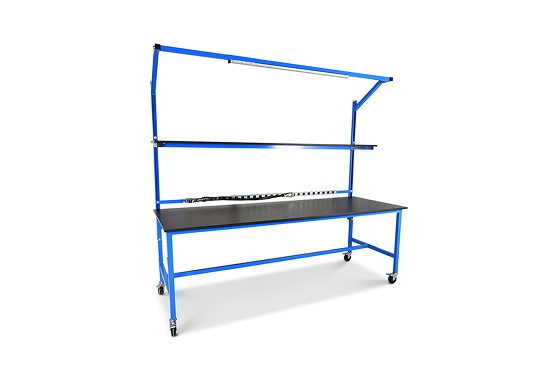
UpperDeck Workbench
An all-in-one workstation with integrated uprights, shelving, and lighting options—perfect for science, engineering, or applied technology labs.

CoreBench
A versatile, durable student table ideal for labs, classrooms, and general-purpose learning spaces. Optional mobility, storage, and finish options available.

Tilting Top Table
Ideal for design studios and visual arts programs, offering a smooth, adjustable tilt surface for technical drawing and creative work.

Drawing Table
A compact and sturdy fixed-angle table for drafting, sketching, and creative disciplines. Clean design with a durable work surface.

Services Lab Bench
Outfitted for labs that require utilities like gas, water, and power. A must-have for chemistry, biology, and life sciences departments.
Key Features: Built for Demanding Academic Environments
Our education workbenches are engineered to meet the daily demands of college labs, classrooms, makerspaces, and collaborative learning spaces—supporting students and faculty with reliable, flexible solutions.
- Heavy-Duty Durability – Built to withstand high-volume student use with powder-coated steel frames and impact-resistant worksurfaces.
- Chemical-Resistant Worktops – Ideal for science labs, available in epoxy, phenolic, or other chemical-resistant materials for safe experimentation.
- Mobility & Flexibility – Optional casters for easy reconfiguration in makerspaces, shared labs, or multi-purpose classrooms.
- Height Adjustability – Sit-to-stand desks and height-adjustable workbenches improve ergonomics for diverse learning activities.
- Integrated Power & Data – Keep labs and tech classrooms connected with built-in power outlets, data ports, and cable management.
- Easy to Clean & Maintain – Smooth, sealed surfaces make daily cleaning and sanitation simple, supporting hygiene protocols.

Campus Spaces We Furnish: Flexible Solutions for Every Academic Environment
Science Labs
Chemistry, biology, and physics labs equipped with durable workbenches, services lab benches, and modular casework.
Engineering & Tech Labs
Robust workstations for fabrication, testing, and hands-on learning, including UpperDeck Workbenches and Utility Workbenches.
Makerspaces
Flexible, reconfigurable furniture for collaborative innovation, from tilting top tables to mobile storage and tool trolleys.
Libraries & Learning Commons
Study tables, collaborative seating, and computer workstations for quiet study or group work.
Training & Instructional Rooms
Instructor desks, student tables, and tilting-top or drawing tables for specialized classroom needs.
Cafeterias & Student Lounges
Durable seating and table solutions designed for high-traffic communal areas.
Administrative & Faculty Offices
Height-adjustable desks, CoreBench tables, and storage tailored for academic offices.
Conference & Meeting Rooms
Tables and chairs built for administrative meetings, planning sessions, or departmental collaboration.
Customization Options: Tailored Workbenches for Every Academic Program
Every institution has unique needs—whether outfitting a science lab, makerspace, or engineering workshop. At Workbenches.com, we offer flexible customization to ensure your furniture supports your specific learning environment.

- Worksurface Choices – Select from chemical-resistant epoxy, phenolic, hardwood, or laminate tops to match campus requirements and budget.
- Size & Layout Options – Custom dimensions, bench configurations, and modular components to fit your classroom or lab footprint.
- Integrated Utilities & Fixtures – Add sinks, gas valves, power strips, or other services directly into the workbench design.
- Mobility Features – Optional locking casters to enable flexible, reconfigurable learning spaces.
- Storage & Accessories – Integrate shelving, drawers, bin rails, pegboards, or tool trolleys for improved organization.
- Color & Finish Selection – Choose from a variety of powder-coated finishes to align with school branding or department aesthetics.
Need a custom assembly workstation?
Contact our team to design a tailored workbench solution that improves workflow and productivity.
Education Workbenches: Common Questions
For Colleges & Universities
A modular, configurable bench system is a strong choice for university research labs where equipment and project requirements may change as grants and research programs evolve. Start with a durable bench platform sized for your current equipment, then use adaptable storage, shelving, power, monitor mounts, and other accessories that can be added or reconfigured as needs change. Height-adjustable and mobile configurations can provide additional flexibility when equipment, researchers, or lab layouts change. Planning for adaptability from the start can help the lab support new projects without requiring a completely new furniture system each time research needs shift. Configure a flexible research workbench in the 3D Workbench Designer.
Typical Workbenches.com lead times vary by product and level of customization. Standard products typically ship within 3–4 weeks, modified products within 4–6 weeks, and customized solutions may take 6–12 weeks, depending on complexity and project requirements. These are estimated lead times and are subject to change, so projects with a fixed semester-break installation window should be planned as early as possible. Share your required delivery or installation dates at the start of the project so our team can help determine the appropriate schedule and identify any timing constraints. See current lead times and answers to common ordering questions.
Nursing and medical technology teaching labs typically need durable, easy-to-clean furniture that supports hands-on instruction, equipment use, storage, and changing class activities. Depending on the program, this may include lab benches or tables, instructor stations, mobile workstations, storage cabinets, seating, shelving, and workstations configured with power or other accessories. Because nursing, med-tech, and other allied health programs use their spaces differently, furniture should be planned around the curriculum, equipment, number of students, cleaning requirements, and how frequently the room needs to be reconfigured. Explore lab furniture solutions for teaching and training environments.
Universities can standardize lab furniture by establishing a core set of bench platforms, worksurface materials, finishes, and commonly used accessories that work across departments, then allowing targeted customization where research requirements differ. A consistent furniture standard can simplify purchasing, replacement, maintenance, and future expansion while creating a more cohesive campus environment. Individual labs can then configure elements such as bench dimensions, height adjustment, storage, shelving, power, mobility, and specialized worksurfaces around their equipment and workflows. The goal is to standardize the platform without standardizing every workstation, giving facilities teams consistency while researchers retain the flexibility they need. Explore configurable workbench options for campus labs.
When ordering lab furniture with grant funds, principal investigators should start by confirming the grant’s allowable expenses, purchasing deadlines, budget limits, and their institution’s procurement requirements. Define the furniture requirements early, including quantities, dimensions, equipment needs, worksurfaces, storage, power, and accessories, so there is enough time for configuration, quoting, internal approvals, production, and delivery. If grant timing is critical, share the funding and project deadlines when requesting a quote. Keeping the furniture scope clearly documented also helps purchasing teams evaluate the quote and move the order through the university’s approval process. Learn how Workbenches.com quoting and ordering works.
For a university lab renovation, provide floor plans or room dimensions, furniture quantities, desired bench configurations, equipment requirements, worksurface materials, storage, power, accessories, and any project specifications. General contractors should also share the project schedule, required delivery and installation window, and relevant site conditions. If installation is included, review our installation requirements for details such as loading access, staging areas, elevators or stairs, room locations, access restrictions, and site-entry requirements. Providing a clearly defined furniture scope and site information upfront helps reduce quoting delays and keeps the furniture package aligned with the construction schedule. Start your university lab furniture project with our Quick Inquiry form.
The main difference is how the bench is used and how much flexibility, equipment support, and customization the workspace requires. Teaching lab benches are typically designed for repeated student use, with durable worksurfaces, accessible storage, power, and layouts that support instruction and multiple users. Research lab benches are more often configured around specific instruments, processes, and individual workflows, with options for specialized worksurfaces, higher load requirements, adjustable height, shelving, power, and equipment integration. Both should be durable and adaptable, but teaching benches prioritize consistent use across classes, while research benches are more likely to be tailored to the needs of a particular lab or project. Explore lab bench solutions for teaching and research environments.
When expanding a teaching lab, universities should plan for both current enrollment and how the space may need to change over time. Start with the number of students and instructors the lab must support, then evaluate circulation, bench dimensions, utilities, equipment, storage, seating, and accessibility. Consider whether power, data, or other services need to reach each workstation and whether mobile or modular furniture could make the room easier to adapt as curriculum and technology change. If the expansion needs to match an existing lab, documenting current bench configurations, finishes, and accessories can also help maintain consistency. Explore configurable furniture solutions for education and teaching labs.
Colleges should identify the furniture scope and estimated budget early in the capital planning process rather than waiting until construction is nearly complete. Determine which fiscal year or funding source will pay for the furniture, when funds must be committed or spent, and what institutional approvals or competitive purchasing requirements apply. Developing bench configurations, quantities, and specifications early gives purchasing teams time to obtain quotes and complete approvals before funding deadlines. It also helps facilities teams coordinate furniture costs with the larger project budget and avoid reducing the furniture scope because it was addressed too late. For projects approaching a funding deadline, review current ordering and lead-time information before establishing the procurement schedule.
A shared teaching and research lab should be planned around what needs to remain consistent and what needs to change between uses. Universities can establish common workstations for routine instruction, then create flexible or dedicated areas for research equipment, specialized processes, and grant-funded projects. Mobile storage, adjustable-height benches, accessible power, and reconfigurable accessories can make it easier to transition the room between classes and research activities. Equipment that cannot be moved or has specialized utility, environmental, or safety requirements may need a dedicated zone rather than a shared workstation. Planning those zones and transitions early helps the lab support students without limiting the specialized needs of sponsored research. Explore furniture solutions for flexible university labs.
Community college career-tech and trades programs typically need workbenches and storage configured around the tools, equipment, and hands-on tasks students perform. Manufacturing and machining programs may need heavy-duty benches for tools, fixtures, and equipment, with high load capacity and organized tool storage. Electronics, mechatronics, and robotics programs often benefit from ESD-safe worksurfaces, integrated power, shelving, monitor mounts, and parts storage. Automotive and maintenance programs may need mobile workstations, locking casters, tool storage, and worksurfaces suited to mechanical work. Engineering and technology labs may benefit from adjustable-height benches that can transition between computer-based work, assembly, testing, and prototyping. Selecting a common configurable bench platform can also help colleges standardize furniture while adapting each classroom to its specific program. Explore workbench solutions for career and technical education.
For K–12 Schools
K–12 STEM classrooms work best with durable, configurable workbenches that can support multiple types of hands-on learning. Look for sturdy worksurfaces, appropriate load capacity, accessible power, and storage for tools, components, and project materials. Mobile benches or tables can help instructors shift between demonstrations, individual work, and team-based projects, while height-adjustable options can accommodate different students and activities. For robotics, engineering, fabrication, and other equipment-intensive programs, benches should also be sized and configured around the equipment students will use. Choosing a common furniture platform with configurable features can help districts support different STEM programs while making future classroom changes and expansions easier. Explore furniture solutions for education and STEM learning.
A school lab bench should combine a durable frame and application-appropriate worksurface with enough capacity for the equipment, materials, and daily wear of student use. Workbenches.com standard heavy-duty workbenches support up to 1,000 lbs., with custom configurations available for applications requiring greater capacity. For classrooms, also consider how the worksurface will handle the chemicals, heat, impact, and cleaning requirements of the curriculum. Programs using robotics, fabrication tools, or heavier equipment may have different requirements than a general science classroom. If your application exceeds the standard capacity or involves specialized equipment, talk with a product specialist about a custom workbench configuration.
Schools can create flexible science classrooms by using configurable furniture and shared infrastructure that can support different experiments, equipment, and teaching formats. Start with modular or mobile workbenches that can be rearranged for lectures, individual experiments, team projects, and demonstrations. Height-adjustable options can accommodate different students and activities, while accessible power, mobile storage, shelving, and organized equipment storage allow the room to change without permanently dedicating every workstation to one subject. Worksurfaces should also be selected for the most demanding activities the room will support, including potential chemical exposure, heat, impact, or frequent cleaning. This approach allows the same classroom to support biology, chemistry, physics, engineering, and other STEM coursework while adapting as curriculum and equipment change. Explore configurable furniture for flexible science classrooms.
Furniture for collaborative STEM learning should make it easy for students to move between individual work, small-group problem solving, and shared building or testing activities. Mobile workbenches and tables can be arranged into team clusters for projects, separated for individual tasks, or opened up for demonstrations and larger builds. Shared storage and mobile carts can keep tools, components, and project materials accessible to multiple teams without crowding individual worksurfaces. Power should be positioned so students can safely use laptops, robotics equipment, test instruments, and other technology wherever teams are working.
The furniture can also be planned around the realities of the room. Workbenches.com can modify standard bench dimensions and configurations to fit odd-shaped rooms, limited wall space, existing equipment, or areas where traditional storage will not work. In many cases, creative combinations of modified bench sizes, mobile storage, shelving, and accessories can solve spatial challenges without requiring a fully custom furniture system. Explore furniture solutions for collaborative STEM learning.
Makerspace furniture should be planned around the activities, equipment, utilities, and movement of people and materials through the space. Start by identifying zones for fabrication, electronics, robotics, assembly, prototyping, and computer-based work, then configure workstations around the needs of each area. Consider worksurface material and size, equipment weight, working height, power access, tool storage, and required clearances. Mobile benches and carts can make shared areas easier to reconfigure, while heavier or utility-dependent equipment may be better served by dedicated workstations.
Storage should also account for more than tools. Makerspaces need organized space for components, raw materials, consumables, works in progress, and completed student projects. Planning these needs alongside the workstations helps keep active work areas clear and makes shared resources easier for students and instructors to access. Explore workbench solutions for makerspaces and education environments.
Schools should budget for lab furniture based on total long-term value, not just the initial purchase price. Start with durable bench frames and worksurfaces selected for the actual demands of the classroom, including frequent cleaning, chemical or heat exposure, impact, equipment loads, and repeated daily use. Furniture with replaceable or configurable components can also extend the useful life of the investment by allowing storage, accessories, worksurfaces, or other features to be updated as programs change instead of replacing the entire workstation.
Schools should also consider future enrollment, curriculum changes, replacement parts, warranties, and whether the furniture can be reused or reconfigured during future renovations. Standardizing around a dependable bench platform can simplify future additions and replacements while helping schools maintain consistency across classrooms and campuses. Explore durable workbench solutions for education environments.