Electronics Assembly Workbenches
Modern electronics assembly requires workstations that combine ESD protection, ergonomic design, smart storage, and workflow optimization to support tasks from component insertion and soldering to inspection and testing. Our electronics assembly workbenches are built with integrated storage solutions, bin rails, pegboards, tool organization systems, monitor mounting, and customization options to enhance productivity and protect sensitive components throughout the assembly process.
Looking for a workstation tailored to your electronics assembly line or lab? Our specialists can help you configure the right solution.
Why Electronics Assembly Workbenches Matter
Electronics assembly environments bring together high-speed production, sensitive components, and detailed task workflows that rely on efficient access to tools, parts, and testing equipment. Purpose-built electronics assembly workbenches help:
- Protect sensitive electronics with ESD-safe worksurfaces and grounding
- Organize parts and tools with bin rails, pegboards, and racks
- Streamline workflows with integrated storage and layout planning
- Enhance operator ergonomics for prolonged focus and reduced fatigue
- Support testing and inspection with monitor systems and utility integration
- Scale as production grows through modular and adaptable configurations
Recommended Electronics Assembly Workbench Solutions: Engineered for ESD Safety, Ergonomics & Workflow Efficiency
These Workbenches.com solutions support electronics assembly, testing, inspection, and kitting workflows. ESD-safe configurations are available where static control is required.
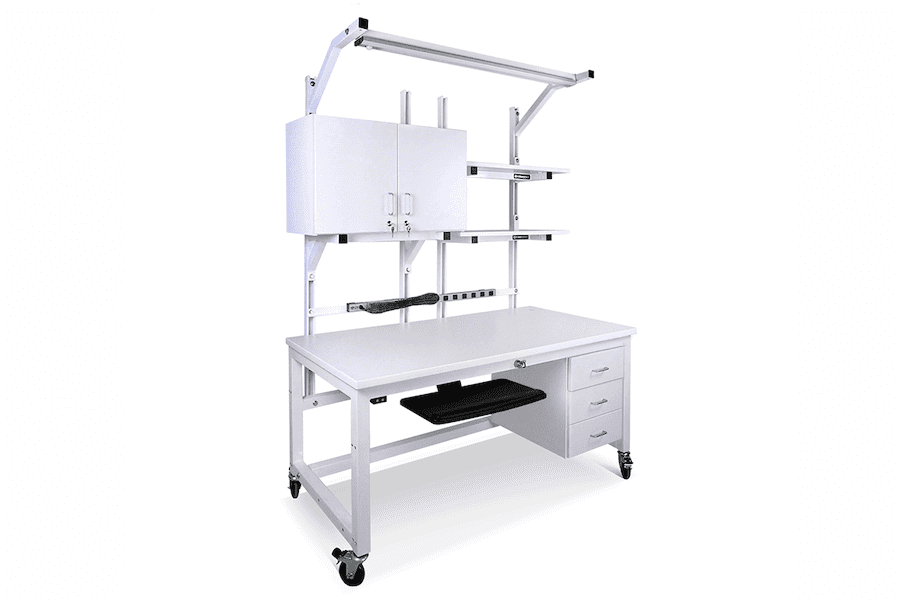
ESD Workbench
ESD-safe configuration of our CoreBench or UpperDeck platforms, equipped with a static-dissipative worksurface and grounding options to protect sensitive components.
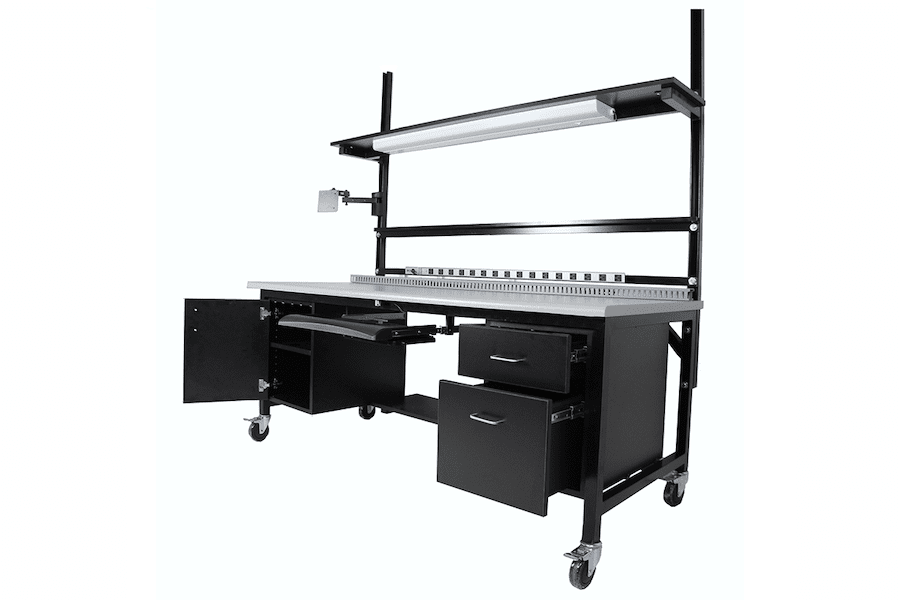
UpperDeck Workbench
Ergonomic workstation with overhead storage, lighting, and accessory support — well-suited for inspection, soldering, and precision assembly. ESD-safe surface options available.
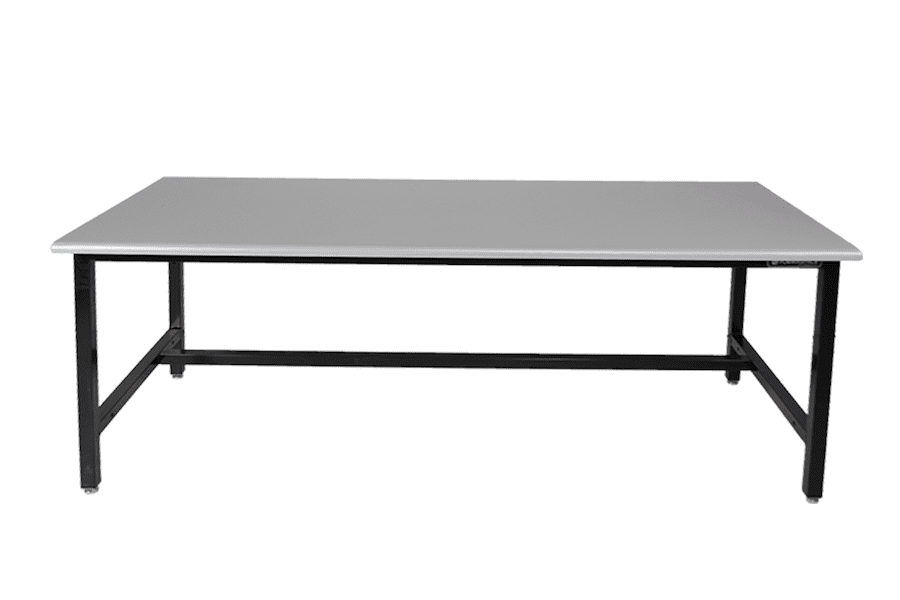
CoreBench
Modular workbench platform ideal for electronics assembly, subassembly, and kitting tasks. Available with ESD-safe worksurfaces and grounding options for static-sensitive components.
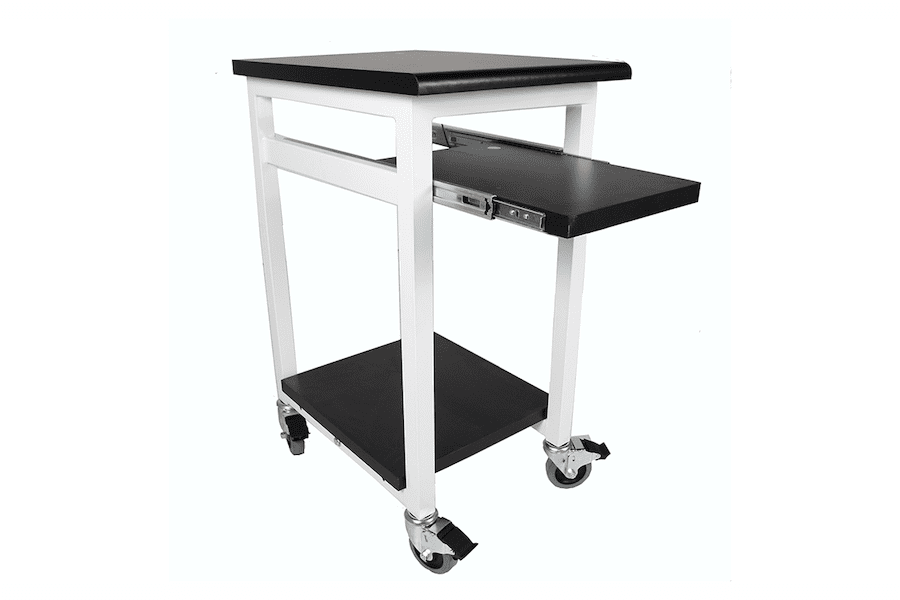
Lab Carts
Mobile, ESD-compatible carts for moving tools, components, test equipment, and assemblies between workstations, production lines, and inspection areas.
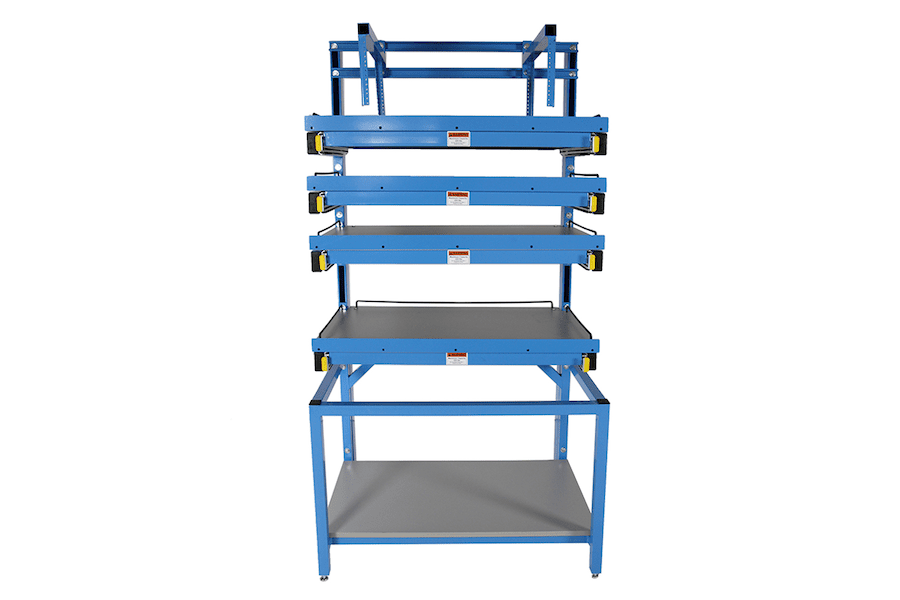
Industrial Storage Racks
Powder-coated or ESD-compatible rack systems for organizing components, reels, kits, and tooling near assembly lines or support zones.
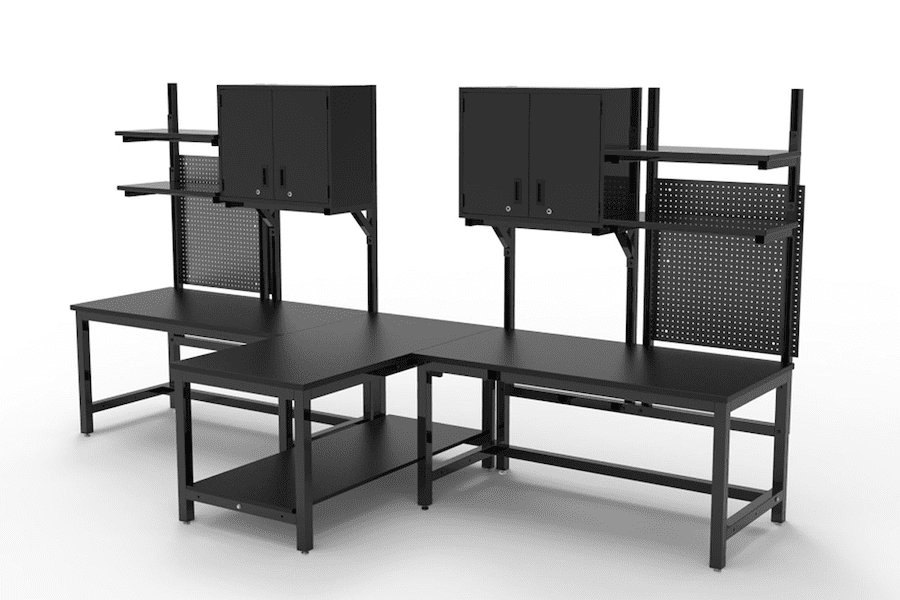
Personalized Workbenches
Custom-engineered configurations built around your assembly process, including bin rails, pegboards, monitor mounts, tool rails, and workflow-specific accessories.
Key Features of Electronics Assembly Workbenches
Electronics assembly workbenches must balance protection, access, and organization. These core features support quality, efficiency, and repeatable assembly output.
- ESD-Safe Surfaces & Grounding – Static-dissipative tops, grounding points, and ESD accessories protect components and assemblies from static damage.
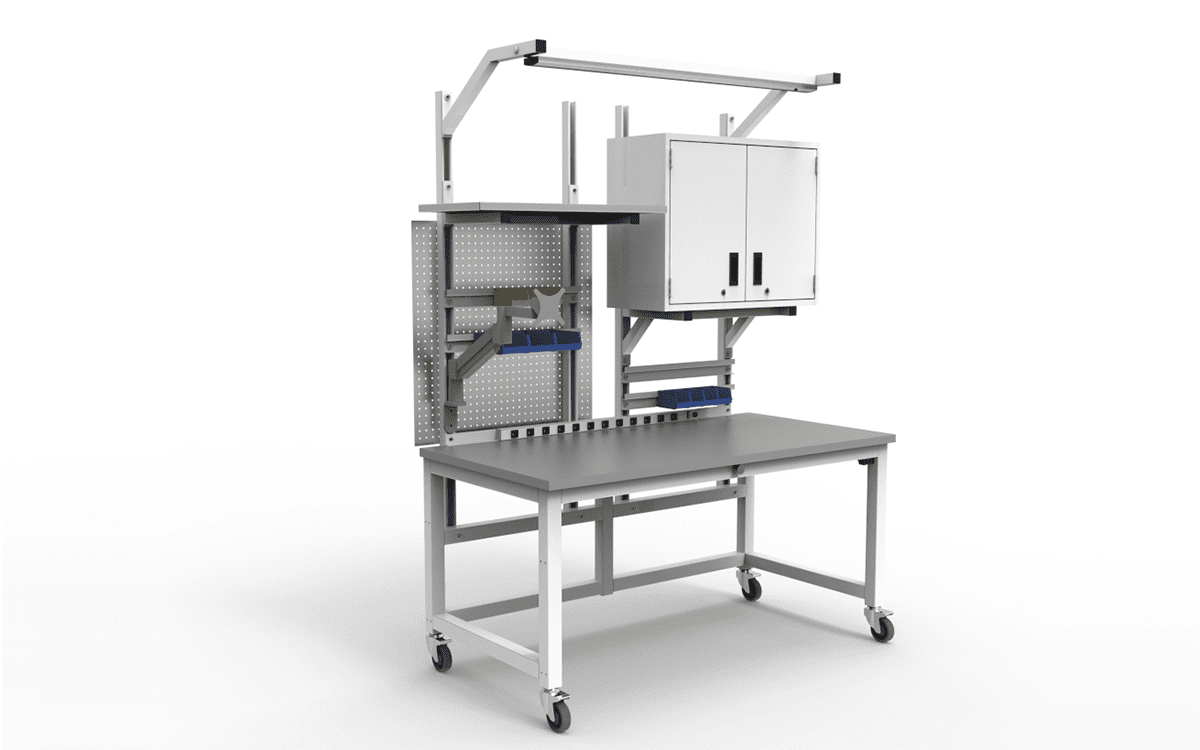
- Versatile Storage & Parts Organization – Integrated bin rails, shelves, pegboards, and rack systems keep components and tools in easy reach.
- Monitor & Tool Mounting Systems – Adjustable monitor arms and tool mounts improve visibility and workflow efficiency on the assembly line.
- Integrated Power & Utilities – Electrical outlets, USB/data ports, and lighting support soldering stations, test equipment, and inspection tools.
- Ergonomic & Adjustable Workstations – Sit-stand options, keyboard trays, and adjustable shelves promote comfort and reduce strain.
- Modular Accessories & Expansion Options – Add drawers, cabinets, cable management, task lights, or tooling panels as your workflow evolves.
Typical Electronics Assembly Use Cases
ESD-Sensitive Assembly Lines
Workstations with static-dissipative surfaces and grounded accessories for PCB handling, component insertion, and connector assembly.
Soldering & Rework Stations
ESD-safe benches with integrated lighting, fume control options, and task-specific tool organization.
Inspection & Quality Control Workstations
Ergonomic benches with monitor mounts and precision lighting for inspection, AOI stations, and testing workflows.
Component Kitting & Parts Staging
Stations with bin rails, rack systems, and shelving to organize reels, trays, and small parts for streamlined assembly.
Functional Testing & Diagnostics Areas
Workbenches integrated with power, data ports, and test equipment mounting to support device testing and validation.
Packaging & Final Assembly Support Zones
Workstations near packing and final verification points to facilitate order fulfillment and quality checks.
Customization Options & Electronics Assembly Workbench FAQs
Electronics assembly environments require tailored workstations that balance static protection, organization, and ergonomic efficiency. These FAQs address common customization considerations.
- Do electronics assembly benches need ESD features?
Yes — most electronics assembly tasks involve ESD-sensitive components, so static-dissipative surfaces, grounding hardware, and ESD accessories are essential. - Can workbenches support bin rails, pegboards, and storage systems?
Absolutely — benches can be configured with integrated bin rails, pegboards, shelves, racks, and drawer systems for organized parts access. - Can these workstations integrate monitor mounts and utility connections?
Yes — workbenches can include adjustable monitor arms, electrical outlets, data ports, and lighting to support inspection and test equipment. - Are these benches suitable for both production and lab workflows?
Yes — modular designs support production line assembly, quality control stations, test areas, and light lab workflows. - Why choose Workbenches.com for electronics assembly workstations?
We understand ESD-critical environments, storage and organization needs, and precision assembly workflows — ensuring your benches are engineered for reliability and efficiency.
Ready to design an electronics assembly workstation tailored to your workflow?
How to Choose the Right Electronics Assembly Workbenches
Selecting the right electronics assembly workstation depends on your task requirements, static sensitivity, and workflow layout. Consider these key factors when configuring your bench.
- ESD Protection Needs – Assess component sensitivity and choose appropriate static-dissipative surfaces and grounding systems.
- Parts Storage & Access – Include bin rails, racks, pegboards, and shelves to keep critical components organized.
- Monitor & Utility Integration – Plan for monitor mounts, power, data connections, and lighting based on inspection and testing needs.
- Operator Ergonomics – Sit-stand options, adjustable shelves, and task lighting reduce fatigue and enhance precision.
- Modularity & Expansion – Modular systems allow you to add accessories or reconfigure layouts as production evolves.
- Space & Workflow Planning – Ensure bench footprints align with line flows, safety zones, and operator movement paths.
Electronics Assembly & ESD Workbenches: Common Questions
An ESD-safe workstation is designed as a complete static-control system, not simply a standard bench with an ESD mat placed on top. A properly configured station can include a static-dissipative worksurface, grounding hardware, a common grounding point for personnel, ESD-compatible seating and accessories, and integration with the facility’s overall ESD control program.
An ESD mat can provide a static-control surface when properly selected, installed, and grounded, but the mat alone does not address every path through which charge can reach sensitive electronics. The worksurface, grounding connections, personnel, seating, flooring, tools, and procedures need to work together.
Explore complete ESD furniture solutions for electronics work.
Start by defining the electronics and processes that require ESD protection, then design the workstation as part of the facility’s overall ESD control program. The bench may need a properly grounded static-dissipative worksurface, personnel grounding connections, ESD-compatible seating and accessories, and coordination with the flooring and other facility-level controls.
Then consider the production requirements around that ESD system: bench dimensions, working height, parts presentation, shelving, storage, lighting, power, monitors, test equipment, and material flow. For an assembly line, standardizing a core workstation configuration can also help maintain consistent ESD controls while allowing individual stations to be configured around different tasks.
Explore ESD furniture solutions for electronics assembly environments.
A grounding kit provides a defined path from the ESD worksurface to ground and can provide a common connection point for personnel grounding devices such as wrist straps. This allows charge to be dissipated through the workstation’s intended grounding system rather than accumulating on the surface or operator.
ESD flooring serves a different part of the static-control system. It can help control charge generated by people and mobile equipment when paired with the appropriate footwear and facility grounding design, but it does not automatically ground the worksurface or replace the workstation’s required grounding connections. Whether both are required should be determined by the facility’s ESD control program and applicable procedures.
There is no single bench height or depth that is best for every electronics rework station. The right dimensions depend on whether technicians work seated, standing, or both; the size and depth of the equipment; viewing distance; parts and tool placement; and the amount of clear worksurface needed for rework.
For shared or multi-shift stations, height adjustment can be particularly useful because technicians can set the worksurface to suit their body size and task. Depth should provide enough room for test equipment and monitors without forcing frequently handled components beyond a comfortable reach. Instead of starting with a standard dimension, size the station around the operator, equipment, and process.
The difference is how readily each material allows electrical charge to move. A conductive surface has lower electrical resistance and allows charge to move more readily, while a static-dissipative surface provides greater resistance so charge can dissipate in a more controlled manner.
For routine electronics assembly, a properly grounded static-dissipative worksurface is commonly used as part of a complete ESD workstation. A conductive surface is not automatically better simply because it moves charge faster. The appropriate surface should be selected according to the facility’s ESD control requirements and the devices and processes being protected.
ESD furniture is designed to support work with static-sensitive components by helping control electrostatic charge at the workstation. Depending on the application, an ESD workstation can include a static-dissipative worksurface, grounding hardware, personnel grounding connections, ESD-compatible seating, storage, carts, and other accessories incorporated into the facility’s ESD control program.
It is typically needed when electrostatic discharge could damage the components, assemblies, or devices being handled. That commonly includes electronics assembly, testing, repair, semiconductor work, and other processes involving electrostatic-sensitive devices. The need for ESD furniture should ultimately be based on the components and facility ESD requirements rather than simply the type of room.
A good electronics assembly workstation should support both the electronics being handled and the person performing the work. Depending on the process, that can include ESD protection, appropriate working height, organized parts and tool storage, accessible power, task lighting, shelving, monitor mounts, cable management, and enough worksurface for assembly and test equipment.
Layout matters as much as the individual features. Frequently used components and tools should be positioned within easy reach, while monitors, instructions, lighting, and test equipment should be placed so they do not interfere with assembly space. Modular accessories can also help the workstation adapt as products, equipment, or assembly processes change.
Explore accessories for configuring electronics assembly workstations
The decision should be based on the facility’s ESD control requirements, the sensitivity of the devices being handled, and how the complete workstation is grounded. Static-dissipative surfaces are designed to move charge toward ground at a controlled rate, while conductive surfaces allow charge to move more readily.
For routine electronics assembly, properly grounded ESD laminate can provide a practical static-dissipative worksurface. Conductive materials may be appropriate for specialized processes, but conductivity alone does not make a surface the better ESD solution. The worksurface needs to function with grounding hardware, personnel controls, flooring, seating, and testing procedures as part of the complete ESD program.
Electronics rework often involves detailed work performed for extended periods, so working height, reach, visibility, and equipment placement are especially important. The technician should be able to position the work close enough for precision tasks without excessive bending or reaching, while tools, components, monitors, and test equipment remain accessible without crowding the primary work area.
Height-adjustable benches can help accommodate different technicians, seated and standing work, and multi-shift operations. Adjustable monitor mounts, task lighting, shelving, and organized tool and parts storage can further adapt the workstation to the operator and task.
Workstation design can reduce unnecessary reaching, bending, twisting, and repositioning by placing frequently used tools, parts, and equipment within the operator’s normal working area. Parts bins, shelving, tool storage, monitors, lighting, and power should be positioned around the sequence of work rather than simply wherever they fit on the bench.
Height adjustment can also help operators position the work appropriately for different tasks and can be especially useful when several employees share a station across shifts. For repetitive assembly, small improvements in parts presentation and reach distance can matter because the same movement may be performed many times during a shift.
Explore workstation accessories for improving operator setup and organization
ESD flooring and ESD workbenches control different parts of the static-control environment. Flooring is generally used to help manage charge associated with people and mobile equipment as part of a properly designed footwear-and-flooring system. An ESD workstation controls static where sensitive components are actually handled through the worksurface, grounding connections, personnel grounding, and compatible workstation components.
One does not automatically replace the other. A facility may use both when its ESD control program requires protection at the operator, floor, and workstation levels. The appropriate combination should be based on the devices being handled, facility procedures, and the complete path to ground.
Explore how ESD workstations fit into a complete static-control environment
Grounding provides the controlled path that allows electrostatic charge to leave the workstation and personnel rather than accumulating where it could discharge into sensitive electronics. A static-dissipative worksurface only performs as intended when it is incorporated into the appropriate grounding system.
A properly configured workstation can include a grounded ESD worksurface, common grounding points, wrist-strap connections, and other ESD-compatible components. Those elements must work with the facility’s flooring, footwear, procedures, and testing program to maintain the intended path to ground. Grounding should therefore be treated as part of the workstation design, not as an accessory added after the bench is installed.