Semiconductor Workbenches
Semiconductor facilities require highly controlled work environments where contamination control, electrostatic protection, and precision are critical to yield and reliability. Our semiconductor workbenches are engineered for cleanroom and cleanroom-adjacent applications, ESD-sensitive processes, and high-precision lab and support operations, delivering modular flexibility without compromising cleanliness or process integrity.
Need cleanroom-ready or ESD-safe workstations for semiconductor operations? Our specialists can help configure the right solution.
Why Semiconductor Workbenches Matter
Semiconductor manufacturing, packaging, and testing require extremely stable and contamination-resistant work surfaces that protect sensitive components and maintain process integrity. Purpose-built semiconductor workbenches enhance:
- Product cleanliness by minimizing particle shedding and human contamination
- ESD protection for circuits, wafers, sensors, and microelectronics
- Workflow accuracy through ergonomic, vibration-stable surfaces
- Process control in assembly, metrology, and inspection environments
- Modularity for rapidly evolving semiconductor tooling and layouts
- Operator safety and comfort during repetitive, high-precision tasks
Recommended Semiconductor Workbench Solutions: Built for Cleanroom Precision, ESD Safety & High-Tech Assembly
These Workbenches.com product lines align with the most common semiconductor applications, from cleanroom-adjacent assembly and labs to inspection, testing, and backend support areas.
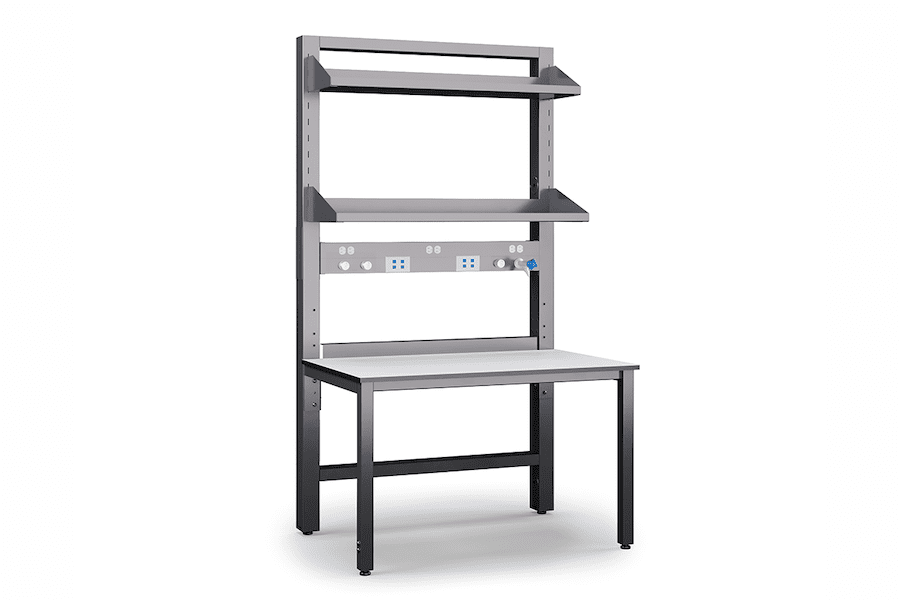
Services Lab Bench
Clean, utility-ready bench designed for semiconductor testing, diagnostics, failure analysis, and contamination-sensitive laboratory environments.
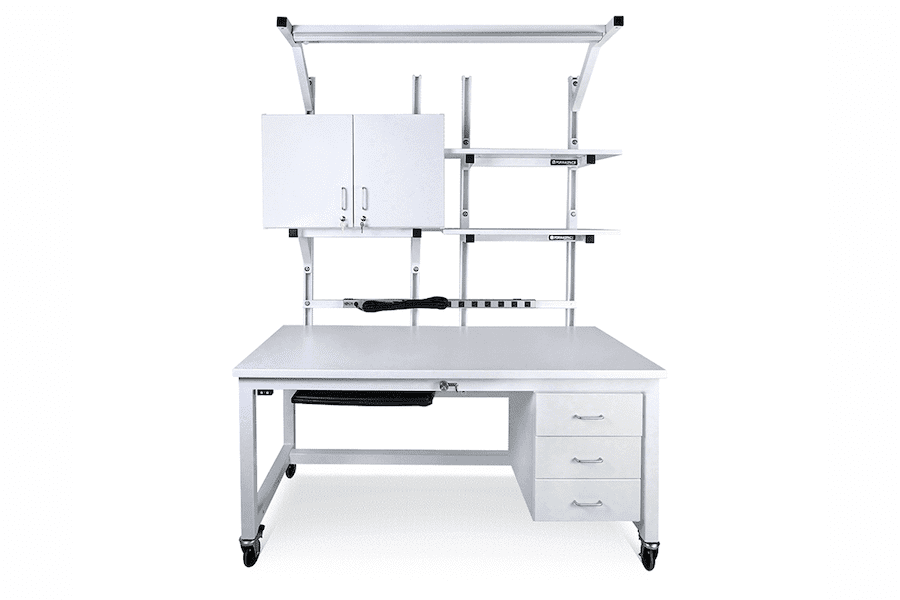
UpperDeck Workbench
Ergonomic workstation with overhead lighting and accessory support — well-suited for inspection, microscopy, metrology tools, and precision electronics work.
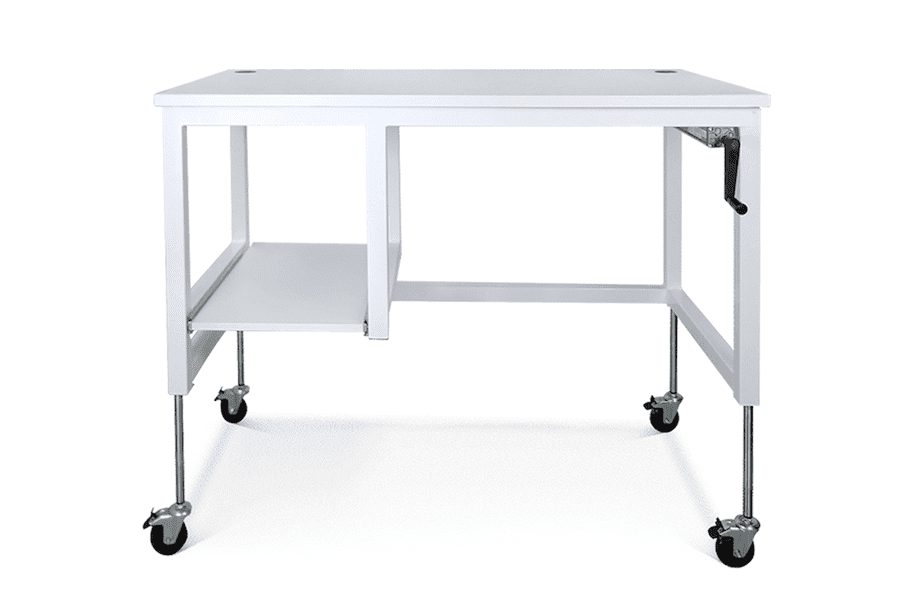
CoreBench
Modular workbench platform ideal for ESD-controlled assembly, subassembly, wafer-handling support tasks, and cleanroom-adjacent tech lab workflows.
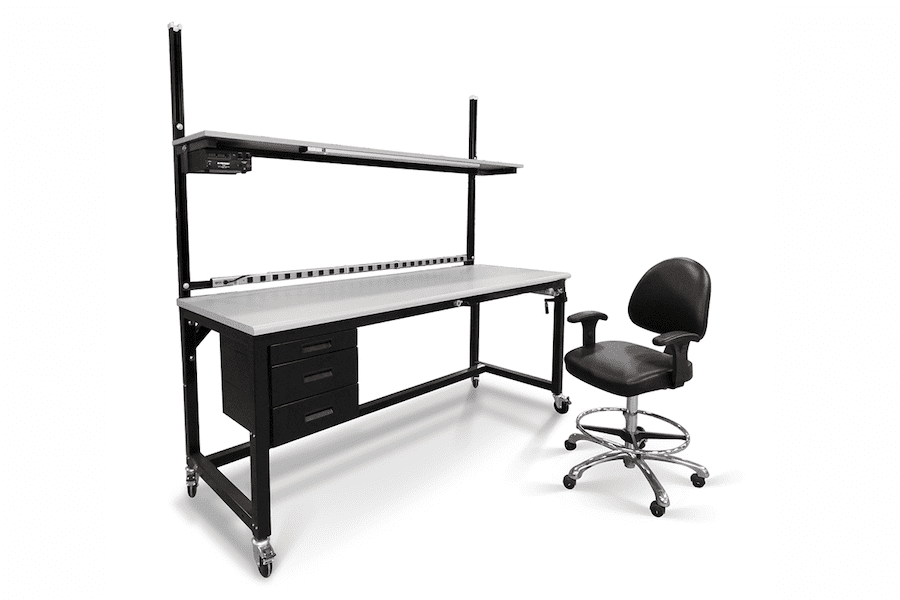
Height - Adjustable Desks
Sit-stand workstations designed for precision tasks, inspection work, and prolonged semiconductor assembly where ergonomics and focus are critical.
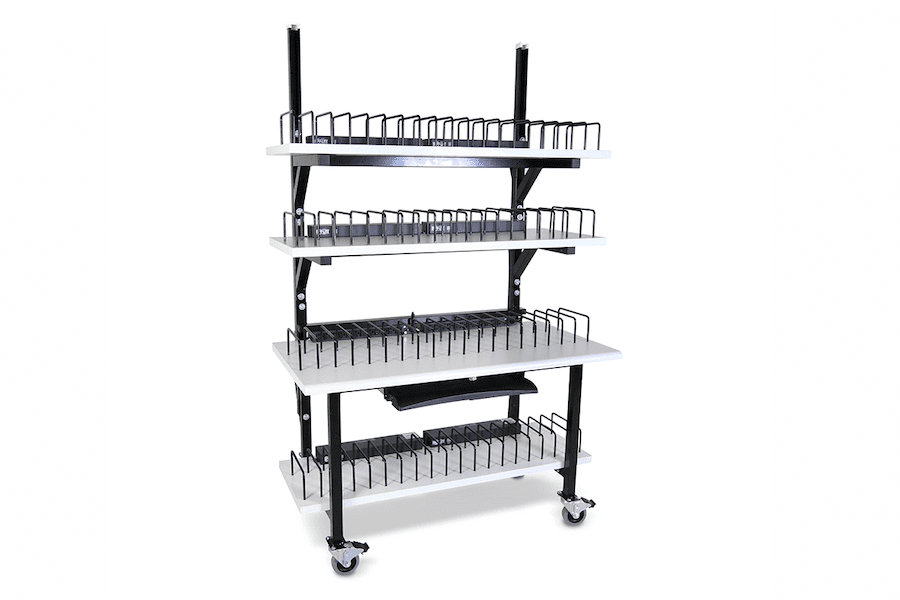
Industrial Storage Racks
Cleanroom-compatible or powder-coated storage solutions for tooling, carriers, consumables, and documentation in cleanroom-adjacent support zones and backend operations.
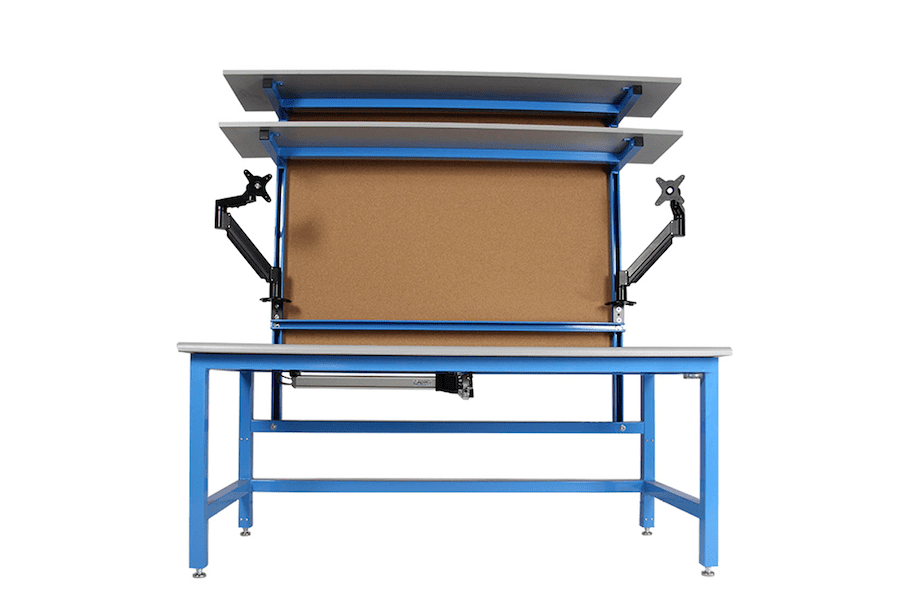
Personalized Workbenches
Custom-engineered configurations for wafer handling stations, ESD-critical assembly, integrated equipment layouts, and specialized semiconductor processes.
Key Features of Semiconductor Workbenches
Semiconductor environments demand workbenches designed around cleanliness, static control, and precision. These features ensure reliable performance across cleanrooms, labs, and support areas.
- Cleanroom-Compatible Construction–Low-shedding materials, smooth surfaces, and powder-coated or stainless-steel frames suitable for controlled environments.
- ESD-Safe Worksurfaces–Static-dissipative laminates and grounding options protect wafers, chips, PCBs, and sensitive microelectronics.
- Precision & Stability–Rigid frames and vibration-resistant surfaces support microscopy, metrology, and inspection tasks.
- Integrated Power & Utilities–Electrical outlets, data ports, lighting, and equipment mounting options support semiconductor tools and lab instruments.
- Modular Accessories & Storage–Shelving, monitor arms, tool rails, and drawers keep work zones organized while maintaining contamination control.
- Ergonomic Adjustability–Height-adjustable options reduce fatigue during long-duration assembly, inspection,and analysis tasks.

Typical Semiconductor Use Cases
Cleanroom - Adjacent Assembly & Wafer Handling Support
Low - shedding, ESD - safe workstations for wafer prep support tasks and controlled assembly outside core fab automation zones.
ESD - Safe Electronics & Package Assembly
Static - controlled benches for chip packaging, PCB integration, and sensitive electronics work.
Metrology & Inspection Workstations
Ergonomic, vibration - stable benches designed for microscopy, measurement tools, and precision inspection.
Semiconductor Lab Testing & Failure Analysis
Chemical - resistant benches supporting diagnostics, material analysis, and R&D labs.
Equipment Setup & Calibration Areas
Stable work surfaces for configuring sensors, test equipment, and instrumentation.
Backend Operations & Support Zones
Workstations and storage supporting test, packaging, documentation, and controlled material staging outside core cleanroom spaces.
Customization Options & Semiconductor Workbench FAQs
Semiconductor workflows often require highly specialized workstation configurations to meet strict cleanliness, static control, and precision standards. These FAQs outline common customization considerations.
- Can semiconductor workbenches be cleanroom-rated?
Yes—workbenches can be configured with low-shedding materials, smoothsurfaces, and cleanroom-compatible components for controlled environments. - Do semiconductor applications require ESD-safe options?
In most cases, yes. ESD-safe worksurfaces and grounding systems are criticalfor protecting wafers, chips, and sensitive electronics. - Can workbenches integrate with microscopes and testing equipment?
Absolutely—benches can be customized with reinforced surfaces, cut-outs, power integration, and mounting options for precision tools. - Are storage and staging solutions used in semiconductor facilities?
Yes—cleanroom-adjacent support zones and backend operations rely oncontrolled storage for tooling, consumables, and documentation. - Why choose Workbenches.com for semiconductor workstations?
Our team understands cleanroom environments, ESD-critical processes, andsemiconductor workflows—allowing us to design workstations that perform reliably from day one.
Ready to design a cleanroom - ready or ESD - safe workstation for semiconductor operations?
How to Choose the Right Semiconductor Workbenches
Choosing the right semiconductor workstation depends on cleanliness requirements, component sensitivity, and workflow precision. These considerations help guide the right configuration.
- Cleanroom Compatibility – Match materials and finishes to ISO cleanroom classifications and contaminationcontrol standards.
- ESD Requirements – Select appropriate static-dissipative surfaces and grounding based on component sensitivity.
- Precision & Stability Needs – Ensure vibration resistance for inspection, microscopy, and metrology tasks.
- Chemical Resistance – Labs and analysis areas may require epoxy, phenolic, or stainless-steel surfaces.
- Accessory & Equipment Integration – Plan for lighting, power, monitors, shelves, and tool mounting.
- Scalability & Modularity – Modular systems allow fast adaptation as semiconductor processes evolve.
Semiconductor Workbenches: Common Questions
A cleanroom-compatible workbench is designed with materials, finishes, and construction appropriate for the controlled environment where it will be used. Key considerations include low-particle-shedding materials, smooth and cleanable surfaces, resistance to required cleaning agents, corrosion resistance, and construction that minimizes areas where particles and contaminants can collect.
The requirements should be matched to the facility’s cleanroom classification and processes. For semiconductor applications, ESD control may also need to be incorporated into the workstation without compromising cleanability or contamination-control requirements.
Start with furniture designed for controlled environments rather than bringing standard industrial furniture into the space. Stainless steel is a strong starting point because it provides a smooth, nonporous, cleanable surface and does not rely on conventional laminate-faced wood construction.
Evaluate the complete workstation—including the frame, worksurface, shelving, storage, hardware, casters or feet, and accessories—for cleanability and potential particle generation. If static-sensitive devices will be handled, ESD requirements should be considered at the same time so contamination control and static control are addressed together.
Because cleanroom classification, ESD requirements, equipment, and cleaning protocols can affect the right configuration, our team can help you narrow down the appropriate materials and workstation options for your semiconductor lab.
Talk with a product specialist about your cleanroom requirements.
Semiconductor facilities can reduce furniture-related particulate risks by selecting smooth, durable, low-shedding materials that tolerate the facility’s cleaning procedures and by avoiding unnecessary surfaces, seams, gaps, or construction details that are difficult to clean.
Furniture should also be evaluated as a complete system. Worksurfaces, frames, shelving, storage, hardware, seating, casters, and accessories can all affect cleanability and particle control. Layout matters as well: staff need sufficient access to clean the workstation and surrounding area according to the facility’s contamination-control procedures.
Cleanroom requirements are typically defined by the facility and process rather than by a universal certification applied to every piece of furniture. ISO 14644 cleanroom classifications, for example, apply to the controlled environment and its airborne particle concentration—not simply to a workbench as an individual product.
When selecting furniture, determine the cleanroom classification and facility protocols first, then evaluate whether the materials, construction, cleanability, particle-generation characteristics, and any ESD components are appropriate for that environment. Semiconductor facilities may also have internal specifications or process requirements that the workstation needs to support.
If your facility has a required cleanroom classification, ESD specification, or internal material standard, share those requirements with our team so we can help determine which furniture options are appropriate.
Cleanroom furniture places greater emphasis on contamination control. Materials and construction are selected for cleanability, low particle generation, durability under repeated cleaning, and compatibility with the controlled environment.
Standard industrial furniture may prioritize strength, load capacity, impact resistance, and general durability without the same particulate-control requirements. Standard laboratory furniture may provide chemical-resistant worksurfaces but can include materials or construction that are not appropriate for every cleanroom.
Cleanroom furniture still needs to perform as a workstation, so equipment loads, ergonomics, storage, shelving, power, mobility, and ESD requirements should be considered alongside contamination control.
Start with the cleanroom and process requirements before selecting individual workstations. Identify the required cleanroom classification, cleaning procedures, ESD controls, equipment, operator tasks, utilities, material flow, storage needs, and any facility-specific restrictions that affect furniture selection.
Then plan each workstation around the process. Consider worksurface material and size, equipment loads and clearances, working height, shelving, storage, power, monitors, lighting, and how materials move into and through the work area. The complete configuration should remain accessible for required cleaning and should avoid introducing unnecessary contamination risks.
Future equipment and process changes should also be considered. Modular workstation components can provide flexibility to adjust shelving, storage, accessories, or layouts as semiconductor processes evolve. Planning these requirements together early can also help avoid specifying furniture that conflicts with equipment, utilities, cleaning procedures, or contamination-control requirements.
Discuss your semiconductor cleanroom project with a product specialist.