Modular Workbenches vs. Fixed Casework: How to Choose the Right Workspace
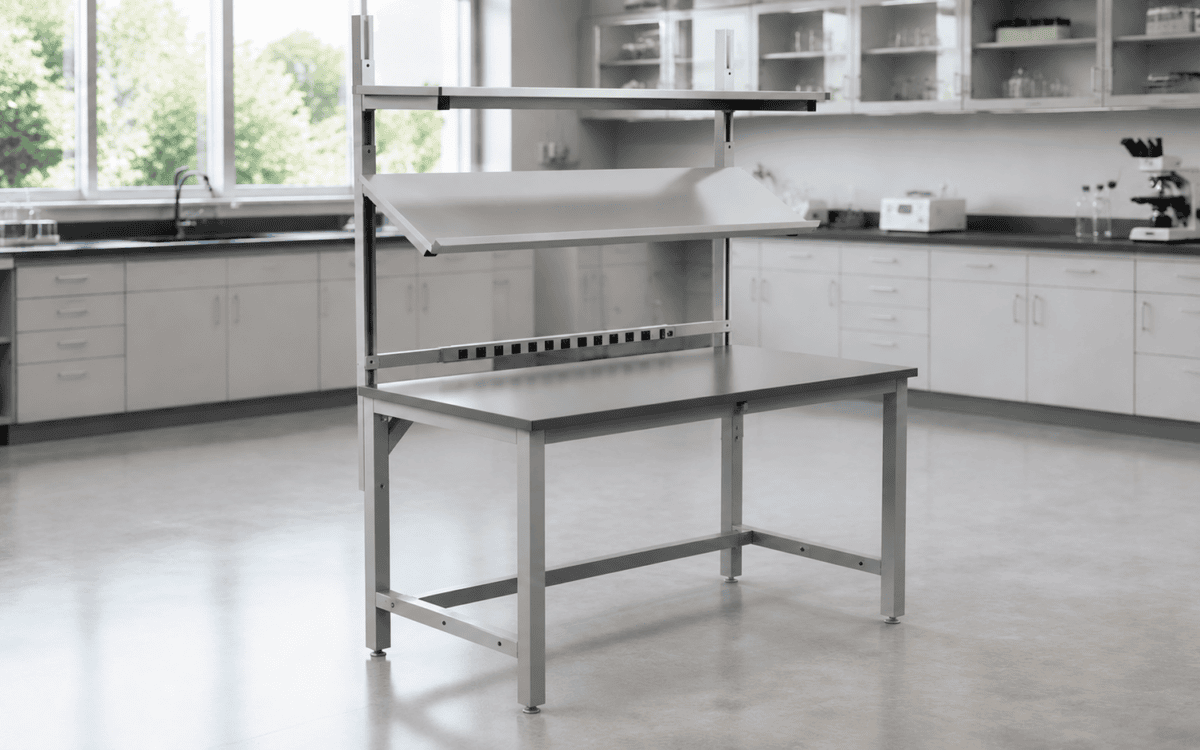
A lab, classroom, or production floor rarely stays exactly the same throughout its useful life. Equipment changes, teams grow, courses evolve, and processes move. At the same time, perimeter storage, dedicated instruments, and long-term utility zones may remain in place for years.
That is why the choice between modular workbenches and fixed steel casework should not begin with a blanket question such as, “Which one is better?” A more useful question is: Where does flexibility add value, and where is a permanent solution more practical?
Fixed steel casework can be the right answer for stable, storage-heavy areas. Modular or mobile workbenches are often a better fit when a space needs to adapt. And many successful facilities combine both approaches rather than forcing one furniture type across the entire room.
Choose fixed steel casework when the layout, storage, and function are expected to remain stable. Choose modular/mobile workbenches when equipment, users, or workflows may change. Use a hybrid layout when the room contains both permanent and evolving zones.
Start With the Work, Not the Furniture
The strongest workspace plans usually begin by separating the room into two kinds of needs: things that should stay put and things that may need to move, expand, or change.
That distinction is more useful than assuming every lab should be fixed or every modern workspace should be modular. The decision should reflect the application, installation requirements, and expected lifecycle of the space. For additional background, see the modular laboratory furniture and fixed casework comparison and the healthcare casework comparison.
When Does Fixed Steel Casework Make More Sense?
Fixed casework earns its place when permanence is useful. It can create continuous storage, a clean built-in appearance, and a stable platform around functions that are not expected to move.
In those situations, flexibility can become an unnecessary feature rather than an advantage. Powder-coated steel fixed casework can also be paired with chemical-resistant worksurfaces such as epoxy resin, phenolic resin, or stainless steel when the application requires it.
But “Casework” Does Not Always Mean Permanently Fixed
There is an important middle ground: Workbenches.com Modular Casework. It provides the organized storage and casework appearance many facilities want, but uses a steel-frame system with removable and replaceable panels so the installation can be expanded, repaired, or reconfigured later.
That matters because one common drawback of traditional fixed casework is not the cabinet itself – it is the difficulty of changing the installation after the room is built. Modular casework reduces that tradeoff. A facility can still create a casework-driven environment without treating every cabinet run as permanent for the life of the building.
When Do Modular or Mobile Workbenches Make More Sense?
Modular workbenches become more valuable as the future becomes less predictable. They are especially useful in R&D, manufacturing, technology, education, and mixed-use environments where the same square footage may support different people, equipment, or tasks over time.
Depending on the configuration, a modular workbench can be:
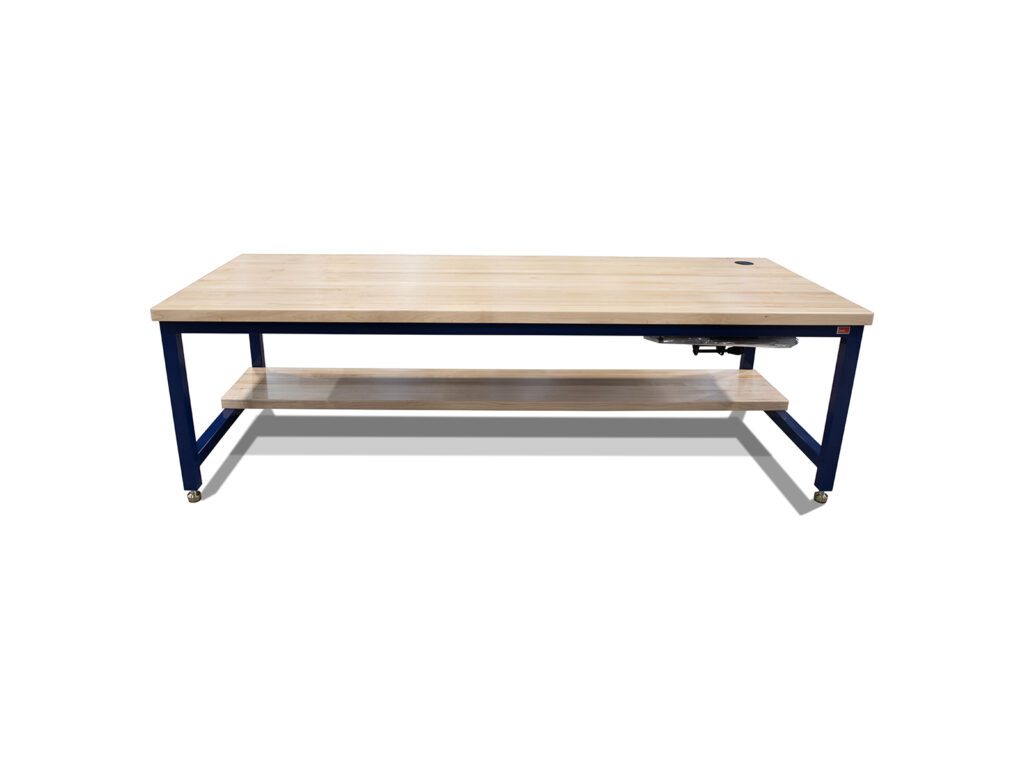
The CoreBench is a good example of this approach: its welded steel frame supports a 1,000-lb capacity, while storage, power, shelving, mobility, and several height-adjustment methods can be configured around the work being performed.
Does Choosing Modular Mean Giving Up Durability?
No. “Modular” describes how a workspace can be configured or adapted; it does not automatically describe how strong the frame is. For industrial applications, the more useful questions are how the frame is built, what load it is designed for, what surface is specified, and how the bench will be used.
Workbenches.com standard heavy-duty benches use fully welded steel frames, which provide a rigid foundation without relying on knock-down frame joints. Standard CoreBench configurations are rated for up to 1,000 lb, and custom applications can be engineered for heavier requirements when needed. This creates a useful combination: a workstation can be physically robust without becoming permanently tied to one layout.
For buyers comparing products, durability should be evaluated through construction method, stated capacity, intended duty cycle, surface selection, and warranty – not by assuming fixed furniture is inherently stronger than modular furniture.
Fixed-Height or Adjustable-Height for a Mixed-Use Assembly Floor?
Height adjustment is a separate decision from fixed versus modular, but it often becomes important in the same projects. A repetitive station used for one process may not need to move vertically. A mixed-use station may.
| FIXED HEIGHT CAN WORK WELL WHEN… | ADJUSTABLE HEIGHT BECOMES VALUABLE WHEN… |
|---|---|
| The same task is repeated at a consistent working height. | Different employees share the station. |
| The operator posture and equipment setup rarely change. | Work alternates between sitting and standing. |
| The process is stable and standardized. | Products, fixtures, or equipment vary in height. |
| Ergonomic adjustments can be handled through seating or accessories. | One station supports multiple assembly or inspection processes. |
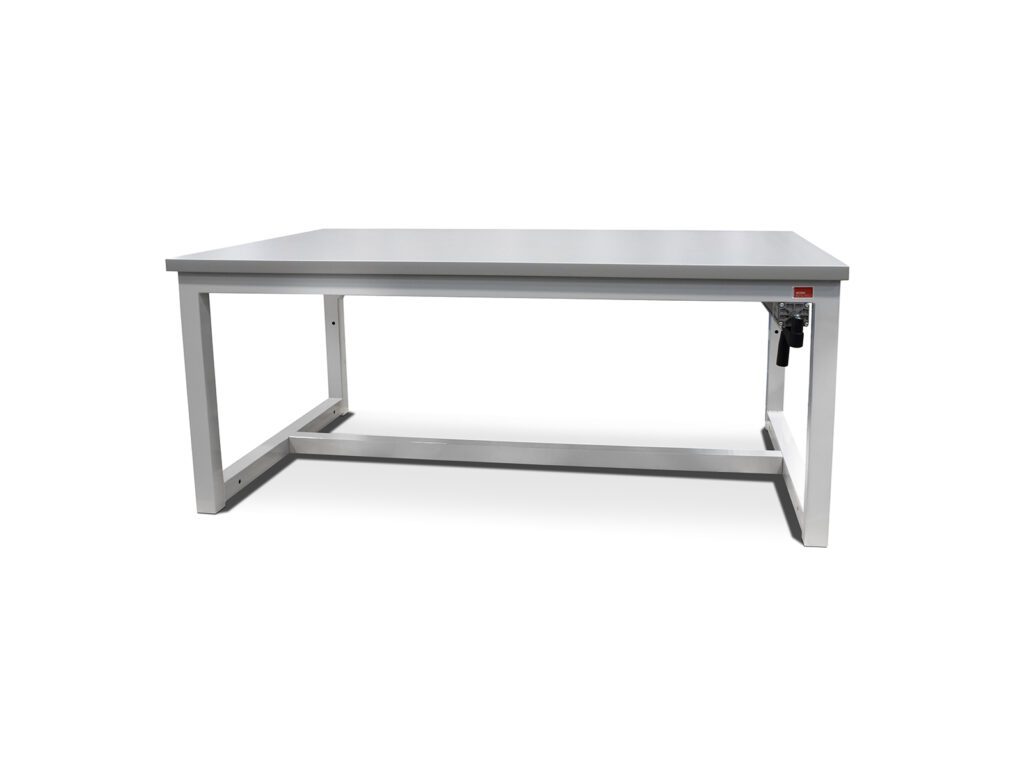
Workbenches.com offers hand-cranked, electric-controlled hydraulic, and height-adjustable legs on appropriate products. Its published warranty information states that standard hydraulic products have a maximum load capacity of 1,000 lb evenly distributed, including the table weight, subject to the listed loading conditions.
University Teaching Lab + Research Space: Why Hybrid Layouts Work
A university lab that serves both teaching and research is a good example of why the answer is often “both.” Teaching methods change. Research programs evolve. New instruments arrive. Enrollment and class formats shift. At the same time, some support functions – sinks, storage, fume hoods, prep areas – may remain in predictable locations.
A practical layout can keep permanent elements around the perimeter while preserving the center of the room for movable or reconfigurable workstations. That approach gives instructors a stable support zone without locking the entire floorplan into one teaching format.
This is not just a hypothetical design idea. Western Washington University’s Environmental Studies Center predesign specifically calls for teaching laboratories that maximize movable lab benches and limit fixed casework around the perimeter. The report says the center workstations can be reconfigured for different layouts depending on the experiments and research being performed. View the official WWU Environmental Studies Center Predesign Report.
Another Western Washington University example follows the same logic. The Carver Anatomy and Physiology Laboratories limited built-in cabinetry and sinks to perimeter walls while using movable and adjustable student and teacher workstations to preserve multipurpose flexibility.
Do Sinks Automatically Require a Fixed Room?
No. Water and drain locations have to be planned carefully, but a sink does not automatically require a room full of traditional fixed casework. The better question is which utilities truly need a permanent location and how much of the surrounding workspace should remain adaptable.
The Saint Mark’s Episcopal School Science Center is a useful example. The project combines modular RGX casework, custom laboratory islands with integrated sinks and built-in storage, perimeter cabinetry, shelving, and drying racks. The result supports a hands-on STEM environment without treating every part of the classroom as a fixed installation.
Fixed Lab Tables or Mobile Tables for a STEM Classroom?
If the classroom is reconfigured often, mobile or modular tables usually have the stronger operational case. A STEM room may need to support lecture, small-group work, equipment demonstrations, wet experiments, project-based learning, or different class sizes in the same week.
Movable furniture can make it easier to:
The idea is well established in higher-education science design. Tradeline’s review of flexible science and engineering facilities documents projects at Michigan State University, the University of Maine, and Rice University that combine movable benches with strategically fixed elements such as sinks and fume hoods.
The Hybrid Approach: Put Permanence Where It Pays
A hybrid plan can be more economical than making the whole room flexible and more future-ready than fixing everything in place. The goal is not maximum movement. It is useful movement: permanent furniture where stability adds value, and modular or mobile furniture where change is likely.
| WORKSPACE NEED | BEST STARTING POINT | WHY |
|---|---|---|
| Permanent perimeter storage | Fixed steel casework | Stable, high-capacity storage where relocation offers little value. |
| Casework appearance with future expansion | Modular casework | Provides cabinetry and storage while allowing later changes. |
| Frequently changing work area | Modular workbench | Can be reconfigured as equipment, workflow, or staffing changes. |
| Shared student / project zone | Mobile or modular bench | Supports different layouts and teaching or project formats. |
| Dedicated long-term instrument | Fixed or dedicated workstation | A stable setup can be more valuable than mobility. |
| Room with permanent + changing functions | Hybrid | Matches each zone to its real lifecycle needs. |
How Can a Facility Reduce Total Cost of Ownership When Choosing Furniture?
The purchase price is visible on day one, but the larger financial impact often appears over the life of the workspace. Total cost of ownership (TCO) includes the initial furniture cost along with installation, maintenance, reconfiguration, downtime, and replacement. For a deeper look at long-term planning, see the Lab Infrastructure Strategies whitepaper.
A useful TCO review should include:
Purchase price varies by project size, furniture complexity, materials, accessories, utility requirements, and installation conditions. Neither fixed nor mobile furniture is automatically the less expensive choice. A fixed installation may provide the best long-term value for a stable application, while a modular or mobile solution may reduce future costs when workflows, equipment, or layouts are likely to change. Buyers should compare the initial project cost with the likely cost of future changes.
The same logic applies to modular casework. Instead of replacing an entire run when requirements change, Workbenches.com Modular Casework uses removable and replaceable panels and an expandable steel-frame system. Likewise, the CoreBench can accept additional storage, shelving, power, lighting, and other accessories as needs evolve.
Warranty Is Part of TCO – But Read the Details
A warranty can be a useful lifecycle indicator, but the headline alone is not enough. A “limited lifetime” warranty may cover different things than a defined-term warranty. Buyers should compare what is actually protected, what is excluded, whether labor is included, whether shift count changes the coverage, and what conditions can void the warranty.
Workbenches.com publishes a 12-year warranty for its manufactured workbenches, tables, casework, storage systems, and qualifying modified/custom products, subject to the stated terms. The published warranty also states that coverage applies regardless of shift count and includes labor when performed under the listed service conditions.
A Simple Decision Guide
If you are still deciding, start with the questions below. They are intentionally practical because most projects do not need a complex formula to identify the right direction.
| ASK THIS QUESTION | IF YES, LEAN TOWARD… |
|---|---|
| Will the layout or process likely change? | Modular / mobile |
| Will new equipment or automation be added? | Modular / hybrid |
| Will different users share the workstation? | Modular + consider height adjustment |
| Does the furniture need to move for teaching, projects, or production? | Mobile / modular |
| Will storage or shelving requirements expand? | Modular workbench or modular casework |
| Is the layout expected to remain stable for many years? | Fixed steel casework |
| Is permanent perimeter storage a major requirement? | Fixed steel casework |
| Does the room have permanent and changing zones? | Hybrid |
| Is first cost the only number being compared? | Pause and evaluate TCO |
Choose for the Next Change, Not Just Today
The best workspace is not the one with the most flexibility or the most permanence. It is the one that places each where it creates real value. Fixed steel casework can provide durable, high-capacity support for stable zones. Modular casework can preserve the casework format while allowing future expansion. Modular and mobile workbenches can give changing work areas room to evolve.
Before choosing, look beyond the opening-day floorplan. Think about the next piece of equipment, the next course format, the next production change, and the next five or ten years of use. A little flexibility in the right place can protect an investment. Too much flexibility where it will never be used can simply add cost.